
Sciatica vs. Piriformis Syndrome: Identifying Your Nerve Pain
It starts without warning: a sharp, electric jolt shoots down the back of your leg, or perhaps a stubborn, hot ache settles deep into your hip and refuses to budge. Walking feels awkward, sitting in the car becomes an endurance test, and finding a comfortable sleeping position requires an elaborate arrangement of pillows.
When nerve pain travels down the lower extremity, the immediate, colloquial diagnosis is almost always sciatica. People hear the word, nod knowingly, and assume a spinal disc has slipped or herniated.
Yet the term sciatica does not describe an actual disease; it merely describes a symptom pattern—an irritation of the sciatic nerve, the largest and longest nerve trunk in the human body. While spinal disc pathology is indeed the most common culprit, it is far from the only one.
Millions of adults who believe they are suffering from an intractable spinal issue are actually dealing with an entirely different anatomical culprit: piriformis syndrome. Because both conditions irritate the exact same nerve pathway, their symptoms overlap dramatically. Treating piriformis syndrome as a spinal disc problem, or treating a lumbar herniation as a simple muscular knot, leads to months of wasted effort, ineffective therapies, and escalating frustration.
Pinpointing the exact physical origin of your nerve pain is the essential turning point on the road to lasting recovery.
Anatomy of the Sciatic Nerve and Its Primary Trouble Spots
To understand why these two conditions masquerade as each other, one must first trace the journey of the sciatic nerve.
The sciatic nerve is roughly the thickness of an adult thumb. It does not originate as a single structure; rather, it is formed in the lower back by the convergence of five separate spinal nerve roots emerging from vertebrae L4, L5, S1, S2, and S3. These individual roots combine within the pelvic basin to form a massive neural cable.
From the pelvis, the sciatic nerve must find a way into the posterior leg. It accomplishes this by exiting through an opening in the pelvic bone called the greater sciatic foramen. As it passes through this narrow anatomical gateway, it crosses immediately beneath—and in some anatomical variations, directly through—a small, band-like muscle called the piriformis.
After clearing the piriformis and traveling beneath the gluteal muscles, the nerve continues straight down the back of the thigh. Near the crease behind the knee, it branches into the tibial and common fibular nerves, supplying sensation and muscular control all the way to the sole of the foot and the tips of the toes.
Because this nerve spans the entire lower body, compression at any point along its path produces sensations that register downstream. The critical distinction lies in where the mechanical pinch occurs:
-
True Sciatica (Lumbar Radiculopathy): The compression happens centrally, at the level of the lumbar spine, where the nerve roots exit the spinal column.
-
Piriformis Syndrome (Deep Gluteal Syndrome): The compression happens peripherally, in the deep gluteal space, where the fully formed sciatic nerve passes beneath or through the piriformis muscle.
True Sciatica: When the Spine Is the Culprit
When clinicians refer to true sciatica, they are almost always diagnosing lumbar radiculopathy. This occurs when the nerve roots exiting the spinal cord are mechanically compressed or chemically irritated by surrounding spinal structures.
The most frequent driver is a herniated or bulging intervertebral disc. The cushion between your vertebrae develops a tear in its tough outer ring, allowing the gelatinous inner core to bulge outward against the adjacent nerve root. Other common spinal causes include degenerative disc disease, facet joint osteoarthritis, bone spurs, and lumbar spinal stenosis—a narrowing of the spinal canal or exit openings that crowds the nerves.
The Hallmark Patterns of Spinal Nerve Compression
True lumbar radiculopathy possesses distinct operational characteristics:
-
Dermatomal Radiation: Because individual spinal nerve roots correspond to specific sensory maps on the skin, spinal sciatica often follows a textbook path. Irritation of the L5 root, for example, reliably sends tingling or numbness across the outside of the calf and into the top of the foot and the big toe. Irritation of the S1 root typically travels straight down the calf into the heel, outer foot, and pinky toe.
-
The Below-the-Knee Rule: True radiculopathy frequently travels past the knee, sending unmistakable nerve symptoms into the lower leg, ankle, or foot. Pain that halts abruptly at the mid-thigh is less likely to originate from a severe disc herniation.
-
The Impact of Intrathecal Pressure: Because the spinal cord and nerve roots reside within a fluid-filled thecal sac, actions that increase intra-abdominal pressure—such as coughing, sneezing, laughing hard, or bearing down during a bowel movement—sharply spike fluid pressure against the irritated nerve root. Experiencing an electric shock down your leg when you sneeze is a classic hallmark of spinal disc involvement.
-
True Neurological Deficits: Significant spinal nerve root compression disrupts motor and reflex arcs. Patients may notice weakness when trying to lift their foot toward their shin, a diminished patellar or Achilles tendon reflex during a clinical exam, or localized numbness where the skin feels dull like leather.
Piriformis Syndrome: The Deep Gluteal Imposter
Piriformis syndrome occurs when the piriformis muscle—a flat, pyramid-shaped external rotator of the hip that runs diagonally from the sacrum to the top of the femur—becomes chronically tight, hypertrophied, inflamed, or locked in spasm.
Because the sciatic nerve passes directly beneath this muscle, any sustained contraction or swelling turns the piriformis into a mechanical clamp, compressing the nerve against the underlying pelvic bone.
In roughly ten to fifteen percent of the population, a congenital anatomical variation exists where the sciatic nerve actually pierces straight through the muscle belly of the piriformis instead of running beneath it. Individuals born with this variation are inherently more susceptible to nerve entrapment whenever the muscle undergoes sustained tension.
Why the Piriformis Clenches
The piriformis does not enter chronic spasm without cause. In modern society, its dysfunction is primarily driven by posture, athletic overcompensation, or direct trauma:
-
Prolonged Sitting and “Wallet Sciatica”: Sitting for hours compresses the deep gluteal space, depriving the piriformis of optimal blood flow. When individuals sit with a thick wallet, phone, or keys in their back pocket, the asymmetric pressure drives the muscle straight into the underlying sciatic nerve, sparking immediate localized ischemia.
-
Gluteal Amnesia and Overuse: When primary hip powerhouses like the gluteus maximus and gluteus medius become dormant from sedentary living, the tiny piriformis is forced to step in as a secondary stabilizer. Unbuilt for heavy structural loads, the piriformis quickly fatigues, tightens, and spasms.
-
Repetitive Rotational Athletics: Runners, rowers, and cyclists who perform repetitive hip motions without adequate lateral hip stability often develop an overworked, hypertonic piriformis.
Key Differentiating Factors: How to Tell Them Apart
While both conditions present with pain in the lower body, careful observation of your symptoms, triggers, and physical responses reveals unmistakable differences.
1. The Epicenter of the Discomfort
With true sciatica, the pain almost always begins in the lower back or sacroiliac region before traveling downward. While back pain can sometimes be mild compared to the ferocious leg symptoms, an identifiable spinal ache or stiffness is typically present.
With piriformis syndrome, the lower back is remarkably clear. The pain originates centrally in the deep meat of the buttock. Patients can often point with a single finger to the exact, tender nodule—located roughly halfway between the tailbone and the hip bone—that sparks their discomfort. Pressing hard into this specific gluteal trigger point will immediately reproduce the shooting symptoms down the leg.
2. Positional Triggers and Relief Postures
Pay close attention to which movements aggravate your symptoms:
-
Forward Bending (Spinal Flexion): Bending forward to touch your toes or slouching in a soft couch pushes lumbar discs backward, typically aggravating true sciatica. Conversely, if your pain stems from the piriformis, gentle spinal flexion without hip rotation rarely reproduces the nerve pain.
-
Hip Rotation and Crossing the Legs: Sit in a chair and cross your painful leg so your ankle rests on your opposite knee (a figure-four position). Now, gently push your knee down or lean your chest forward. If this triggers a sharp, biting pain deep in the buttock, the piriformis is screaming.
-
Sitting on Hard Surfaces: Sitting on a wooden bench, bleacher, or hard car seat concentrates mechanical pressure directly over the piriformis muscle. People with piriformis syndrome find hard surfaces intolerable within minutes, whereas disc-related sciatica is often worse in deep, bucket-style car seats that force the lumbar spine into a rounded posture.
3. Physical Provocation Checks
Physical therapists and orthopedic clinicians use specific movement screens to isolate the pain generator:
-
The Straight Leg Raise (Lasègue’s Test): Lie flat on your back with both legs straight. Have someone slowly lift your symptomatic leg into the air while keeping your knee completely locked. If a sharp, electric pain shoots down your leg between thirty and seventy degrees of elevation, the test is positive for spinal nerve root tension.
-
The FAIR Test (Flexion, Adduction, Internal Rotation): Lie on your side with the painful hip on top. Bend your top knee to a ninety-degree angle, bring the knee across your body toward the floor (adduction), and rotate your foot toward the ceiling (internal rotation). This position puts maximum physical stretch directly across the piriformis. If this maneuver reproduces your signature nerve pain, deep gluteal entrapment is the primary suspect.
Why Misdiagnosis Derails Recovery
Treating nerve pain without identifying its true anatomical driver is like trying to fix an electrical short by replacing the light bulb when the issue is in the circuit breaker.
The most common, disastrous mistake occurs when someone with a lumbar disc herniation assumes they have a tight piriformis and attempts aggressive stretching. Poses like the pigeon pose or deep cross-body hamstring stretches require extreme hip flexion and pelvic tucking. For an extruded lumbar disc, this forceful rounding drives the nuclear material further out of the disc, worsening nerve compression and potentially causing permanent root injury.
Conversely, treating piriformis syndrome with spinal interventions—such as lumbar traction, epidural steroid injections into the spine, or surgical microdiscectomy—will leave the patient in identical pain because the true site of entrapment in the buttock remains untouched.
Furthermore, aggressive, unguided foam rolling directly over an inflamed piriformis often backfires. If the sciatic nerve is already swollen and irritated, grinding it against the hard edge of a lacrosse ball or dense foam roller adds blunt mechanical trauma, triggering severe neurogenic inflammation.
Targeted Action Plans for Each Condition
Once you have identified the likely source of your symptoms, your rehabilitation strategy must shift to address the specific mechanical environment causing the entrapment.
Reclaiming the Spine: The Sciatica Protocol
When the pain originates from a lumbar disc issue, the goal is to reduce intradiscal pressure and encourage the nerve root to desensitize:
-
Find Your Directional Preference: Many disc-related issues respond favorably to gentle spinal extension. The classic prone press-up (lying on your stomach and pressing your upper body up while leaving your hips relaxed on the mat) helps guide disc fluid forward, away from irritated posterior nerve roots.
-
Spine-Sparing Mechanics: Eliminate rounding through the lower back during daily tasks. Master the hip hinge when lifting groceries, tying shoes, or getting out of a chair. Keep the spine locked in a neutral position, moving through the hips rather than the lumbar joints.
-
Neural Mobilization (Nerve Gliding): Rather than forcefully stretching an irritated nerve, practice gentle sciatic nerve flossing. While seated, extend the painful knee while simultaneously tilting your head backward toward the ceiling, then bend the knee while bringing your chin to your chest. This slides the nerve back and forth through its neural sheath like dental floss, breaking up adhesions without pulling the tissue taut.
Freeing the Hip: The Piriformis Syndrome Protocol
When the entrapment sits in the deep gluteal space, the objective is to down-train the overactive piriformis and re-engage the surrounding musculature:
-
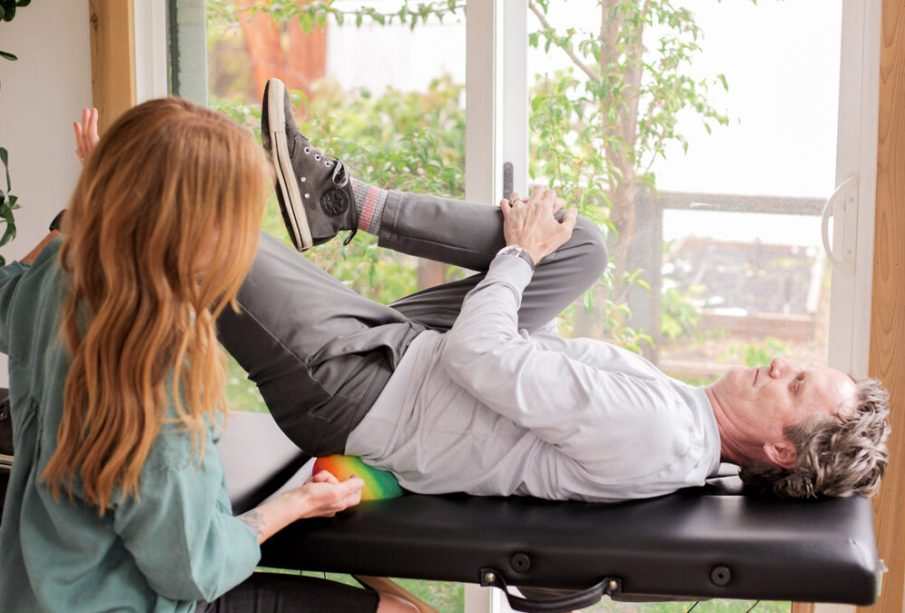
Calm the Hypertonic Spasm: Instead of crushing the muscle with a hard roller, use gentle, sustained ischemic compression with a soft therapy ball or palm pressure for thirty to forty-five seconds, followed by gentle, heat-assisted relaxation.
-
Awaken the Gluteal Movers: A tight piriformis is almost always an overworked piriformis. Rebuild the strength of the primary hip abductors and extensors—particularly the gluteus medius and gluteus maximus. Side-lying clamshells with a neutral spine, lateral band walks, and double-leg glute bridges train the larger muscles to assume their rightful mechanical duties.
-
Ergonomic Decompression: Remove wallets and phones from back pockets permanently. If you work a desk job, alternate between sitting and standing every forty-five minutes. When seated, use a supportive wedge or coccyx cushion that tilts the pelvis slightly forward, keeping the hips higher than the knees to prevent the piriformis from staying in an over-shortened, compressed state.
Navigating the Path to Relief
Living with radiating leg pain is exhausting, draining your physical energy and clouding your daily focus. Yet the human body is remarkably logical: nerve pain does not strike at random, and nerves do not scream without a physical catalyst.
Take the time to evaluate your symptoms with precision. Look beyond the generic label of sciatica and ask whether your pain is driven by a spine that needs stability or a deep hip muscle that needs decompression.
By identifying the exact location of the bottleneck and applying the appropriate, targeted interventions, you can quiet the irritated nerve, restore your natural movement, and step forward free from radiating pain.