
Desk Worker Lower Back Pain: Why Stretching Makes It Worse
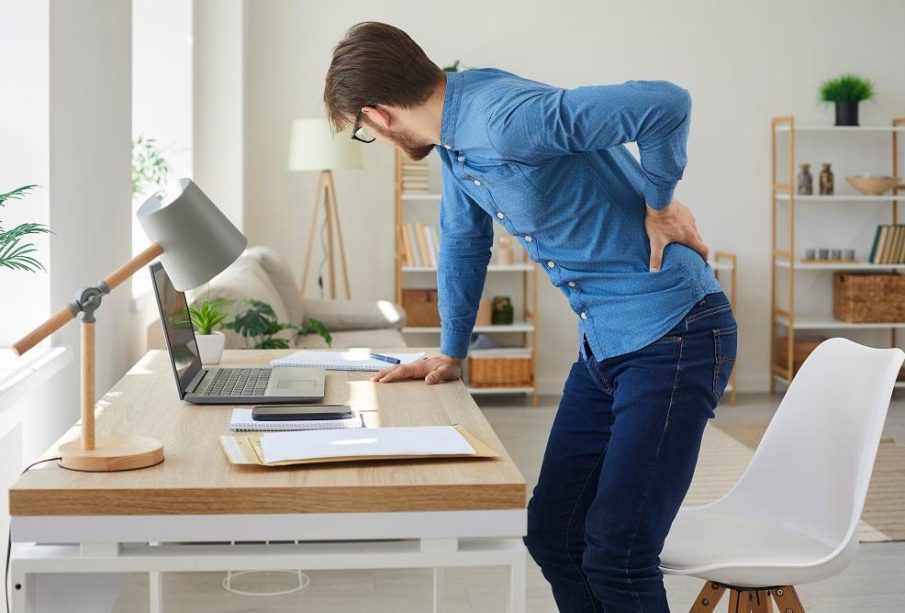
Around three o’clock in the afternoon, a familiar ritual unfolds across offices and remote workspaces nationwide. A desk worker pushes their chair back, stands up with a stiff groan, and instinctively bends forward to touch their toes. Others drop to the floor to pull their knees tightly against their chest, while some twist their torsos aggressively across the back of an office chair until they feel a succession of dull pops along their spine.
The logic seems indisputable on the surface. Sitting in front of a computer screen for eight or ten hours makes the lower back feel locked, compressed, and painfully tight. If a muscle feels tight, common sense suggests you ought to stretch it.
Yet for millions of office workers, this instinct leads directly into a chronic pain loop. The stretch provides a brief, deceptive window of relief, only for the deep, aching throb in the lumbar spine to return an hour later with doubled intensity.
The frustrating truth is that typical flexibility routines rarely fix sedentary lower back pain; in many cases, they actively accelerate the underlying damage. Treating desk-bound back pain requires abandoning the myth of flexibility and understanding why an aching spine almost always demands structural stability instead.
The Illusion of Relief: Why Stretching Feels Good Before It Hurts
If stretching a painful lower back is counterproductive, why does it feel so satisfying in the moment?
The answer lies in neurology rather than structural healing. When you aggressively stretch an irritated muscle, you activate specialized sensory organs called Golgi tendon organs and muscle spindles. This intense stretch stimulus floods the spinal cord with sensory signals that temporarily override and drown out local pain signals.
This neurological phenomenon is known as the stretch reflex analgesic response. By placing the tissues under extreme tension, you effectively numb the local pain sensors for fifteen to thirty minutes.
Simultaneously, the stretch forces hyper-reactive muscles to temporarily drop their defensive guard. To the desk worker, this registers as immediate physical release.
However, this relief is purely transient. You have not lengthened a tight muscle, realigned a joint, or decompressed an irritated disc. You have merely applied a biological anesthetic to an unstable joint. Once that neurological dampening fades, the central nervous system realizes that the underlying spinal structure is even less stable than it was before. In response, it orders the surrounding muscles to spasm even tighter to protect the spine from collapsing, triggering a painful rebound cycle.
Flexion Creep and the Biomechanics of the Slumped Spine
To understand why stretching backfires, one must examine the mechanical environment created by modern desk work.
When you sit in a standard office chair, your pelvis naturally rotates backward into a posterior pelvic tilt. This rotation flattens the natural, gentle inward curve of your lower back—known as lumbar lordosis—forcing the lumbar spine into continuous flexion.
The human spine is not an inert stack of wooden blocks; it is composed of viscoelastic tissues, including the intervertebral discs, the posterior longitudinal ligament, and deep connective fascia. Viscoelastic materials possess a distinct mechanical property: when subjected to a constant, prolonged load, they deform over time. This deformation is known biomechanically as creep.
During hours of slumped sitting, the posterior elements of the spine are subjected to continuous low-grade tension. The ligaments gradually stretch, lose their resting tension, and become lax. Meanwhile, the gelatinous fluid inside your intervertebral discs—the nucleus pulposus—slowly migrates backward against the fibrous outer ring, the annulus fibrosus.
By the time you stand up at the end of the workday, your spinal stabilizing ligaments are temporarily stretched out like loose elastic bands, leaving your lumbar discs completely exposed to abnormal mechanical stress.
When your immediate reaction to this state is performing a standing toe touch or pulling your knees to your chest, you subject those already overstretched, creep-deformed posterior tissues to maximum end-range flexion. You take discs that have been under backward hydraulic pressure all day and forcefully pinch their front edges together, driving the internal disc material even further against irritated nerve roots.
The Tightness Trap: Protective Tension vs. Shortened Muscles
The greatest conceptual error in treating desk-bound back pain is confusing an anatomically short muscle with an overstretched, guarded muscle.
When people say, “My lower back is tight,” they are describing a subjective sensation, not a physical measurement. Muscle tissue can produce the sensation of tightness under two completely opposite physical conditions:
-
Shortness: A muscle that is contracted and shortened in resting length, such as the psoas or hip flexors after prolonged sitting.
-
Strain and Protective Spasm: A muscle that is overstretched, overloaded, and contracting at maximum effort to act as a structural guy-wire for an unstable joint.
In the case of a desk worker, the erector spinae muscles and the deep multifidus along the lower back are not short. Because the spine has spent the entire day rounded forward, those muscles have been held in an elongated, under-tension state for hours. They feel rock-hard and exhausted because they are firing continuously to keep your spine from collapsing further into flexion.
Their “tightness” is not a dysfunction; it is an intelligent, emergency protective mechanism deployed by your brain. The muscle is acting as a natural cast to immobilize a vulnerable spinal segment.
When you force that guarded muscle into a deep stretch, you are trying to break the cast off an unhealed fracture. You rip away the only dynamic defense mechanism your nervous system has constructed, leaving the passive structures of the spine—the discs and facet joints—to bear the entire gravitational load unsupported.
The Problematic Stretches Desk Workers Must Stop Doing
Many traditional stretching routines draw heavily from classical yoga poses and gym cooldowns that were designed for upright, mobile athletes, not people who spend forty hours a week sitting in ergonomic chairs. Several standard stretches are particularly problematic for sedentary backs.
The Standing or Seated Toe Touch
Reaching down for the toes while keeping the knees straight is the most common reflex for lower back stiffness. It is also one of the most mechanically destructive movements for a flexion-intolerant back.
In individuals with tight hamstrings or poor hip mobility, the pelvis quickly stops rotating forward. To bridge the remaining distance to the floor, the movement forces twenty to thirty degrees of pure flexion through the lumbar segments under the full weight of the upper torso. This spikes intradiscal pressure dramatically, grinding irritated facet joints and stretching already compromised posterior ligaments.
The Double Knee-to-Chest
Often prescribed in outdated physical therapy handbooks as a gentle way to open the lower back, pulling both knees to the chest while lying flat flattens the lumbar lordosis completely.
While it temporarily decompresses the posterior facet joints—providing that seductive, brief hit of pain relief—it drives significant posterior disc bulging. For someone with an underlying annular tear or minor disc bulge, repeated knee-to-chest maneuvers prevent the outer fibrous wall of the disc from ever scarring over and healing.
Aggressive Seated or Supine Twists
Grabbing an office chair and wrenching the shoulders around to stretch the mid-back and hips places extreme rotational torque across the lumbar vertebrae.
The thoracic spine—the mid-back anchored by the ribs—is designed for rotation, boasting roughly thirty-five degrees of natural rotational mobility. The lumbar spine, by contrast, is an architectural column built for stability, possessing only about five to ten degrees of total rotational freedom across its entire length.
When a desk worker whose mid-back has stiffened from typing tries to force a twist, the motion bypasses the rigid thoracic spine and tears through the lumbar facet joints and the diagonal fibers of the lumbar discs, which are exceptionally vulnerable to combined twisting and bending forces.
The Joint-by-Joint Reality: Stability vs. Mobility
Resolving chronic back pain requires looking at the body through the lens of functional biomechanics, which reveals a clear pattern of alternating needs across human joints:
-
Ankles: Require mobility.
-
Knees: Require stability.
-
Hips: Require multi-planar mobility.
-
Lumbar Spine: Requires multi-planar stability.
-
Thoracic Spine: Requires mobility.
-
Scapulae: Require stability.
Notice that the lumbar spine sits as a stable, force-transmitting bridge between two highly mobile power centers: the hips and the thoracic spine.
When you sit at a desk all day, your hips lock up in flexion, your gluteal muscles go dormant from continuous pressure, and your thoracic spine stiffens into a kyphotic, forward-rounded hump. When you finally stand up and try to move, lift an object, or simply walk, your body still requires movement.
Because your hips and mid-back are frozen, your nervous system takes the path of least resistance. It forces the lumbar spine to move instead.
Your lower back begins bending, twisting, and flexing to compensate for immobile hips and a rigid mid-back. What the lower back needs is not more range of motion; it needs the stiffness and muscular bracing required to resist unwanted motion. The goal is to make the hips mobile and the spine bulletproof.
What Actually Works: Sparing the Spine and Building Stiffness
Healing desk-bound lower back pain requires shifting your paradigm from stretching tissue to sparing tissue, followed by building functional stiffness.
Mastering the Hip Hinge
The primary movement pattern every desk worker must learn is the hip hinge.
A hip hinge is the act of bending forward entirely through the ball-and-socket joints of the hips while keeping the spine locked in a neutral, undisturbed position.
To practice this, stand with your feet shoulder-width apart, soften your knees slightly, and place your fingertips on your hip creases. Instead of bending your waist or reaching down toward your toes, push your hips straight backward toward the wall behind you, as though you were trying to close a car door with your glutes while carrying groceries. Your torso will naturally tilt forward, but your spine remains an unchanging, rigid beam.
Mastering the hip hinge allows you to tie your shoes, pick up packages, and get in and out of your desk chair without flexing your lumbar spine a single millimeter.
Building Isometric Core Stiffness
Crunches, sit-ups, and back extensions force the spine through repetitive flexion and extension, worsening tissue creep. To protect the back, you must train the core musculature for its true biological purpose: resisting movement.
Three foundational isometric exercises provide maximum core stiffness with minimal spinal load:
-
The Modified Curl-Up: Lie on your back with one leg straight and one knee bent, placing your hands palm-down under the natural curve of your lower back to ensure your lumbar spine does not flatten against the floor. Lift only your head and the top of your shoulders an inch off the mat, holding the contraction for seven to eight seconds while breathing normally. This fires the rectus abdominis without flexing the lower spine.
-
The Side Plank: Lie on your side supported by your elbow and knees (or feet for advanced individuals). Lift your hips until your body forms a straight line from your ears to your ankles. This intensely activates the quadratus lumborum and obliques, critical lateral stabilizers that prevent harmful sideways shearing forces on the lumbar vertebrae.
-
The Bird-Dog: Position yourself on all fours with your hands under your shoulders and your knees under your hips. Maintain an unwavering neutral spine while simultaneously reaching your right arm forward and your left leg straight back until both are parallel to the floor. Hold for six to eight seconds, return, and alternate sides. This engages the deep multifidus, glutes, and posterior chain without imposing compressive loads on the discs.
Performing these movements with short, high-tension holds rather than training to exhaustion creates a protective muscular girdle that guards your spine throughout the workday.
The Power of the Decompression Walk
The intervertebral discs lack a direct blood supply; they rely entirely on an internal fluid pump mechanism to receive nutrients and clear metabolic waste products.
Sitting motionless suffocates the discs by maintaining static compressive fluid loss. Static stretching only worsens the localized mechanical strain.
The most potent, natural antidote to desk-bound back pain is brisk, non-fatiguing walking. Walking with an upright posture, an active stride, and a natural, relaxed arm swing creates gentle, alternating reciprocal loading through the spine. This acts as an active hydraulic pump, drawing fluid, oxygen, and nutrients into the discs while desensitizing irritated nerve pathways.
Replacing your afternoon toe-touch routine with a purposeful ten-minute walk around the block does more to alleviate lower back ache than twenty minutes of intense floor stretching ever could.
Rewriting the Daily Routine
Living free from desk-induced back pain does not require quitting your job or investing in exotic ergonomic machinery. It requires aligning your daily movement habits with human spinal anatomy.
Stop trying to yank an irritated spine into compliance with deep forward bends and aggressive twists. Recognize the sensation of stiffness for what it truly is: an urgent request from your nervous system for stability and support.
When you learn to mobilize your hips, stabilize your core through isometric strength, and keep your spine in neutral alignment during daily tasks, the deep, chronic ache will finally have no reason to exist.